Uzbekistan
Khiva
- Best time
- March to November
- Climate
- Sharp continental
- Currency
- Som
- Language
- Uzbek, Russian
About this place
Khiva: The Desert Pearl of Uzbekistan
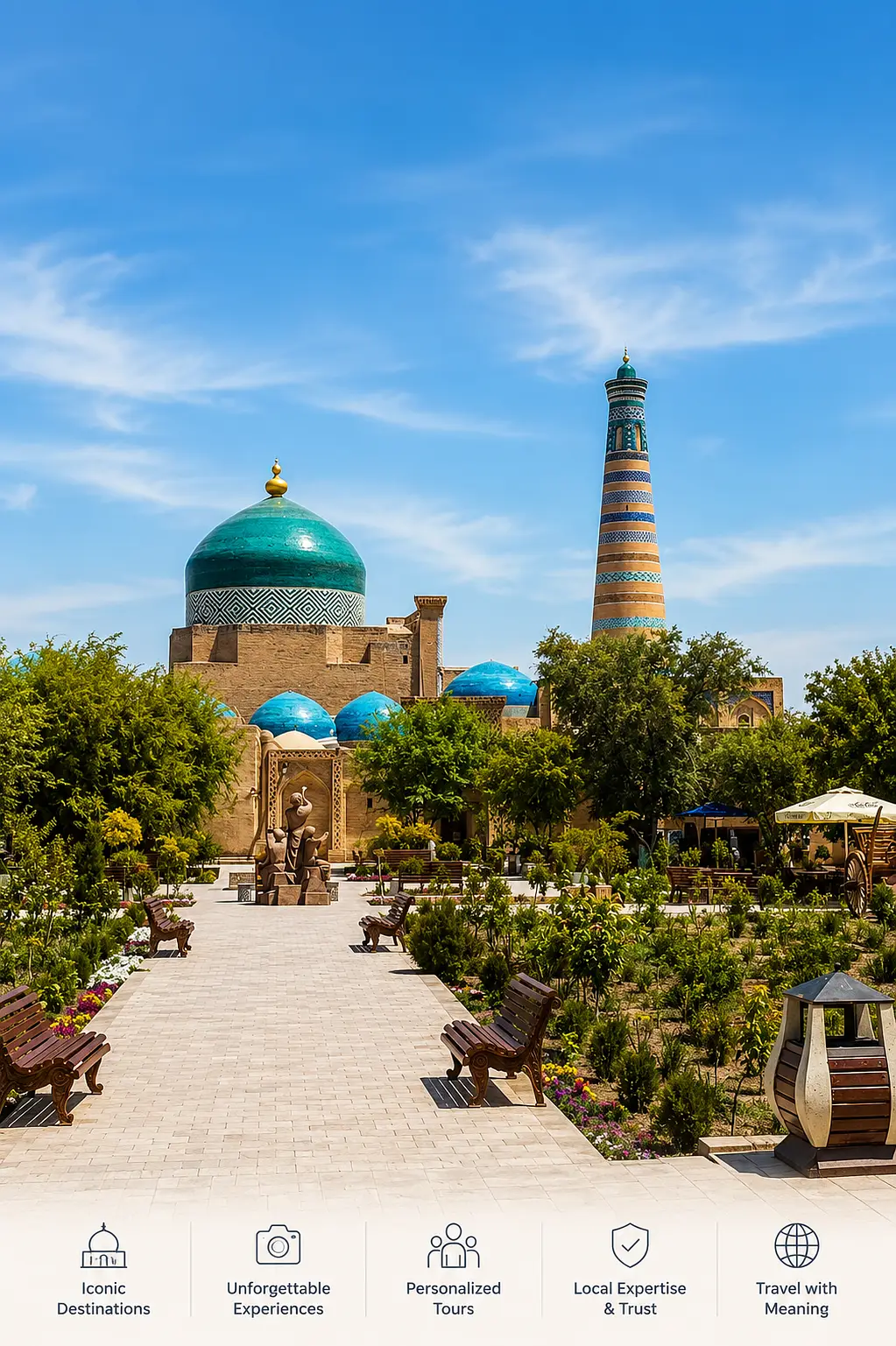
There's a stillness to Khiva that visitors rarely forget. Step through the gates of its walled old town, Itchan Kala, and the modern world all but disappears — only the electrical wires overhead give away the century. Cobbled lanes, clay-walled mosques, and towering minarets remain almost exactly as they were centuries ago, earning this desert city its reputation as Uzbekistan's open-air museum and its entire old town a place on the UNESCO World Heritage List.
Marginalia
Travel tips
A City Born of Legend
Local legend traces Khiva's origins to a well called Heyvak, said to have been dug by Sim, son of the biblical Noah. Archaeologists confirm the city (then known as Kheyvak) existed as early as the 6th century BC, and the ancient well can still be found in the city center today. Before the Arab conquest, Khiva was a Zoroastrian city; centuries later, during the 9th to 11th centuries, it became a genuine center of science and religion, home to scholars such as Al-Khwarizmi and Al-Biruni.
Khiva's fortunes rose sharply after Genghis Khan's forces destroyed it in 1220 — Uzbek tribes arrived in the 16th century, and in 1598 Khiva was proclaimed capital of the Khanate of Khiva, entering a golden age of mosque and madrasah construction that continued through the 18th and 19th centuries. Russian forces partially conquered the khanate in 1873, the last khan was overthrown in 1920, and Khiva became part of the Uzbek SSR in 1924.
Inside Itchan Kala
The 26-hectare walled city of Itchan Kala is Khiva's crowning attraction, home to roughly 300 families — many of them hereditary artisans — and to the State Historical and Archaeological Museum-Reserve. Construction of the fortress began in 1598, though scholars believe fortifications existed on the site as far back as the 5th century. Its defensive walls, some 5–6 meters thick and up to 10 meters high, stretch for 6,250 meters and can be climbed near the northern gate for sweeping views over the old city.
Kalta Minor Minaret
Khiva's most recognizable landmark, this striking turquoise-tiled minaret was meant to be the tallest in the Islamic world at 70–80 meters. Construction stopped at just 29 meters in 1855 following the death of its patron, Muhammad Amin Khan — leaving behind an unusually squat, brilliantly tiled tower that remains one of Central Asia's most photographed structures.
Kunya-Ark Citadel
A fortress within the fortress, begun in 1688 as the residence of the khans of Khorezm. Within its walls stood mosques, a harem, a mint, and the royal reception hall — a self-contained seat of power separated from the rest of Itchan Kala.
Islam-Khoja Complex
Home to Khiva's tallest minaret at 56 meters, visible from nearly anywhere in the old town, this early 20th-century madrasah-and-minaret complex honors a reforming prime minister of the Khivan court.
Juma Mosque
Unlike any other mosque in the city, Juma Mosque has neither dome nor portal — instead, 213 wooden columns support its roof, 21 of which date back to the 10th–12th centuries, alongside carved doors crafted in 1316.
Pahlavan Mahmud Mausoleum
A deeply revered pilgrimage site honoring a 12th–13th-century folk hero born to a family of artisans. Over time, a mosque and Sufi monastery grew up around his grave, and several Khivan rulers chose to be buried here as well.
Tash-Hovli Palace
Built in 1838 by Allakuli Khan, this was the primary residence of Khiva's rulers, decorated with intricate frescoes, carvings, and ganch plasterwork, and divided into sections for the khan's private life, his wives' quarters, and formal state functions.
Nurullabay Palace
The rulers' summer residence, completed in 1912, is notable for a throne room designed in Russian Art Nouveau style, complete with imported tiled stoves from the Imperial Porcelain Factory in St. Petersburg — a striking contrast to the rest of the old city's architecture.
Beyond the Icons
Additional highlights include the unusually austere Ak Mosque, the brick Arab Muhammad Khan Madrasah (built without decorative majolica), and the Shergazi Khan Madrasah, whose alumni included celebrated poets and Sufi holy men from across the region. A traditional silk carpet workshop offers visitors a rare look at hand-weaving techniques passed down through generations of local artisans.
Museums of Khiva
The Museum of the History of Khorezm showcases archaeological finds from the ancient settlements of Koirylgan-Kala and Toprak-Kala, including manuscripts and ceramic fragments predating the modern era. The Museum of Applied Arts and Everyday Life displays 18th- and 19th-century jewelry, ceramics, and woodwork, while the Museum of Crafts — unique in Uzbekistan — focuses on the work of hereditary jewelers, blacksmiths, and potters. Music lovers should visit the Museum of the History of Musical Art of Khorezm, housed in the historic Kazy-Kalyan madrasah.
Culture, Parks, and Shopping
Two theaters keep Khiva's performing arts alive: the Khorezm Musical Drama Theater, staging Uzbek-language productions since 1933, and a beloved puppet theater whose largely wordless shows appeal to visitors and locals alike.
Given the desert heat, Khiva's parks are modest but well loved — Khiva Park, set against the old city walls, offers boating on its small pond, while the Khiva Locomotive amusement park is a popular family outing. For souvenirs, ceramics, textiles, and jewelry, the shops within Itchan Kala are the most convenient stop, while the city bazaar offers a more local, everyday shopping experience.
A Taste of Khorezm
Khiva is the best place in Uzbekistan to try authentic Khorezm cuisine. Don't miss shivit oshi — green dill noodles served with a rich vegetable gravy — or tukhum barak, delicate dumplings filled with raw egg that sets as they cook. Restaurants such as Shiva Moon, Yasawulbashi, and Caravan serve these regional specialties alongside standard Uzbek fare. Dedicated vegetarian restaurants are not common, though meat-free dishes are available on request at most local establishments.
Getting Around and Getting There
Note that no vehicles operate inside Itchan Kala itself — everything within the walls is explored on foot. Outside the old city, minibuses run roughly from 7:00 AM to 9:00 PM, and Uzbekistan's only trolleybus line connects Khiva to nearby Urgench, a route opened in 1998 to mark the city's 2,500th anniversary. Taxis are widely available, and bargaining over fares is standard practice.
Khiva is served by Urgench International Airport, about 31 kilometers away, with connections to Istanbul, Moscow, St. Petersburg, and other regional cities via airlines including Turkish Airlines and Uzbekistan Airways. Rail service also connects Khiva to cities throughout Uzbekistan.
Language and Safety
Uzbek is the primary language, with Russian widely understood; younger residents and those working in tourism often speak at least some English. Khiva is a notably calm and safe city, particularly within the historic center, with a visible police presence throughout.
Step Back in Time in Khiva
Let Stan Roads arrange your private tour of Itchan Kala, a stay inside the walled old city itself, or a full Khorezm region itinerary including the desert fortresses beyond Khiva. Contact Stan Roads to begin planning.