Uzbekistan
Bukhara
- Best time
- March to November
- Climate
- Sharp continental
- Currency
- Som
- Language
- Uzbek, Tadjik, Russian
About this place
Bukhara: A Living Museum of the Islamic World
Few cities on earth wear their history as openly as Bukhara. Wander its old quarter and you're walking among mosques, madrasahs, and mausoleums that have stood for a thousand years — a UNESCO World Heritage Site so complete that it feels less like a collection of monuments and more like a city that simply never stopped being medieval. Today, this home to over 275,000 people balances that extraordinary heritage with the everyday rhythms of modern Uzbek life.
Marginalia
Travel tips
Bukhara Through the Ages
Bukhara's roots stretch back roughly 2,500 years, with archaeological finds — pottery, jewelry, building remains — dating to the 5th century BC. Its name first appears on coins from the 4th–5th centuries, and by the 7th century the Chinese traveler Xuanzang was already writing about the city. Historians trace the name itself to an Old Uighur word meaning "prayer house," though the city was known by many names across different cultures and eras.
Bukhara reached its first golden age as capital of the Samanid Empire in the 9th and 10th centuries, a period that drew towering intellectual figures such as the physician-philosopher Ibn Sina (Avicenna) and the poet Rudaki. Even after losing its status as capital, the city continued to flourish architecturally, and under Amir Timur it became known as Bukhoroi Sharif — Holy Bukhara — a title reflecting its growing importance as a center of Islamic faith and learning. Many buildings were lost after the 1917 revolution, and the city became part of the Uzbek SSR in 1925. In 2020, Bukhara was named the capital of Islamic culture by the Organization of the Islamic World for Education, Science, and Culture.
Unmissable Sights in Bukhara
The Ark Fortress
The oldest monument in the city, with a documented history reaching back to the 5th century and archaeological evidence of fortifications as early as the 4th century BC. Within its walls once stood a royal palace, reception halls, a library, a mint, and even a prison — and scholars including Ibn Sina and Rudaki worked here. Today it operates as a museum-reserve showcasing medieval court life and archaeological finds.
Poi-Kalyan Ensemble
The spiritual and architectural centerpiece of Bukhara, anchored by the 46.5-meter Kalyan Minaret, built in 1127 to call the faithful to prayer. Facing it are the Kalyan Mosque — rebuilt in 1514 and capable of holding 12,000 worshippers — and the Miri-Arab Madrasah, once among Central Asia's most prestigious religious schools and remarkably one of the only functioning madrasahs in the entire Soviet Union during parts of the 20th century.
Samanid Mausoleum
The sole surviving structure from the Samanid dynasty, built in the late 9th or early 10th century and remarkably unchanged in a thousand years. Its intricate brickwork earned it a place on the UNESCO World Heritage List in 1993.
Lyabi-Hauz Ensemble
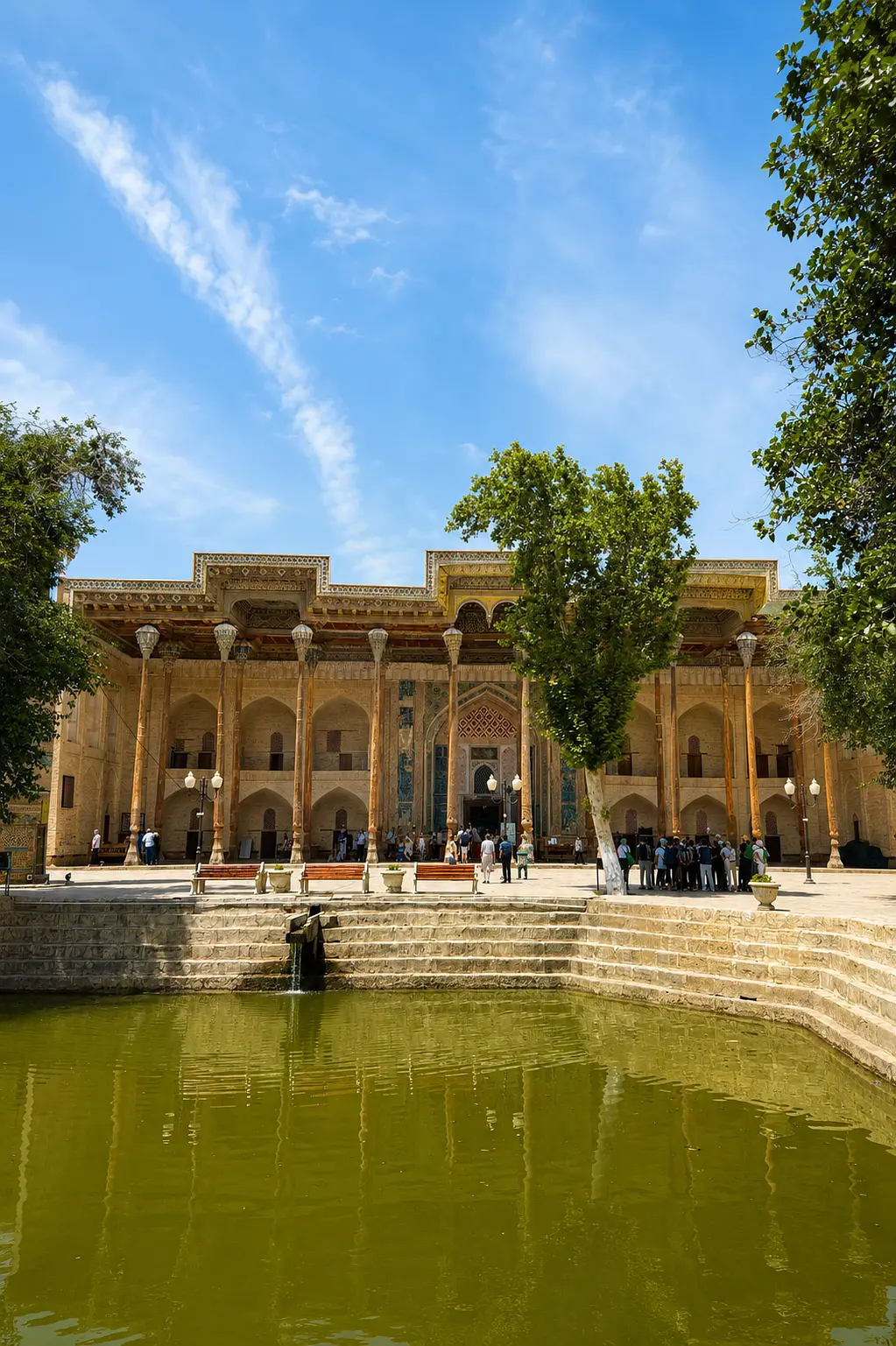
Centered on a tranquil pond that has anchored community life here since the 16th century, Lyabi-Hauz remains Bukhara's most beloved gathering spot, ringed by teahouses and framed by a statue of the beloved folk trickster Khoja Nasreddin. Nearby, the Kukeldash Madrasah (1569) — the largest religious school in Central Asia — and the animal-and-bird-decorated Nadir Divan-Begi Madrasah, originally built as a caravanserai, round out the ensemble.
Chor-Minor
A small but striking 1806 madrasah known for its four distinctive domed minarets, each decorated in a different style — a design many believe symbolically nods to different world faiths.
Chashma-Ayub Mausoleum
A sacred well-site tied to the biblical figure of Job, said to have struck the ground with his staff to bring forth water for a thirsting population. The well itself dates to 1380 and remains a site of pilgrimage for Muslims and Christians alike.
Sitorai Mokhi-Khosa Palace
The country residence of Bukhara's last emir, completed in 1918 and now a museum of decorative arts, prized as much for its lavish interiors as for its historical significance.
Naqshbandi Memorial Complex
Just outside the city, this mausoleum and mosque complex honors Khoja Bakhouddin Naqshbandi, the 14th-century founder of the influential Naqshbandi Sufi order and spiritual advisor to Amir Timur. Many visitors consider it Central Asia's most important pilgrimage site outside Mecca itself.
The Old Jewish House and Beyond
Near Lyabi-Hauz, the Old Jewish House offers a rare window into the history of Bukhara's Jewish community, with a 250-year-old cellar and a small gallery of textiles and photographs. Elsewhere, Chor-Bakr — Central Asia's largest necropolis — and the striking Abdulaziz Khan Madrasah reward those who venture beyond the headline sites.
Museums Worth Your Time
The Bukhara State Architectural Art Museum-Preserve (est. 1922) anchors the city's museum scene with hundreds of historical exhibits. The House Museum of Fayzulla Khodjaev honors the reform-minded Jadid leader through personal artifacts, while the Museum of Carpet Weaving History traces regional textile traditions from the 18th century to today. Hands-on visitors will enjoy the Blacksmith History Forge Museum, where you can watch — or try — traditional ironwork, and the nearby Gijduvan Ceramics Museum, home to six generations of a single ceramics family.
Shopping and Local Flavor
The domed Trading Domes of Bukhara have functioned as commercial hubs for centuries and remain the best place to find handmade ceramics, knives, daggers, and silver jewelry from the region's hereditary craftsmen. For fresh produce and everyday local life, head to Buhoro Dehqon Bozori.
When it comes to food, Bukhara's version of plov draws particular praise — many locals point to the Labi Hovuz restaurant as the benchmark — while spots like Old Bukhara, Shafran, and the Xo'ja Nasreddin café serve dependable regional classics. Dedicated vegetarian restaurants are scarce, though many Uzbek and Asian kitchens offer meat-free dishes on request.
Getting Around and Getting There
Bukhara's public transport includes more than 30 bus routes running roughly 6:00 AM to 9:00 PM, alongside shared route taxis. Ride-hailing is available through the local Yoko Taxi app, and car rental (including through international partners) is possible, though options are more limited than in Tashkent or Samarkand.
Bukhara International Airport connects to Moscow, St. Petersburg, Istanbul, and other regional cities via several airlines, while the high-speed Afrosiyob train links Bukhara to Tashkent and Samarkand — note that the railway station sits in Kagan, about 15 kilometers outside the city center.
Language and Safety
Uzbek and Russian are both widely spoken, with English available in hotels and tourist-facing businesses. Bukhara maintains a strong police presence and is considered safe to explore both day and night, with the usual common-sense precautions.
Step Into Bukhara's Old City
Stan Roads can arrange a private Bukhara city tour, a day trip to the Naqshbandi complex or Gijduvan's ceramics workshops, or a full multi-city Silk Road journey built around your interests. Contact Stan Roads to get started.